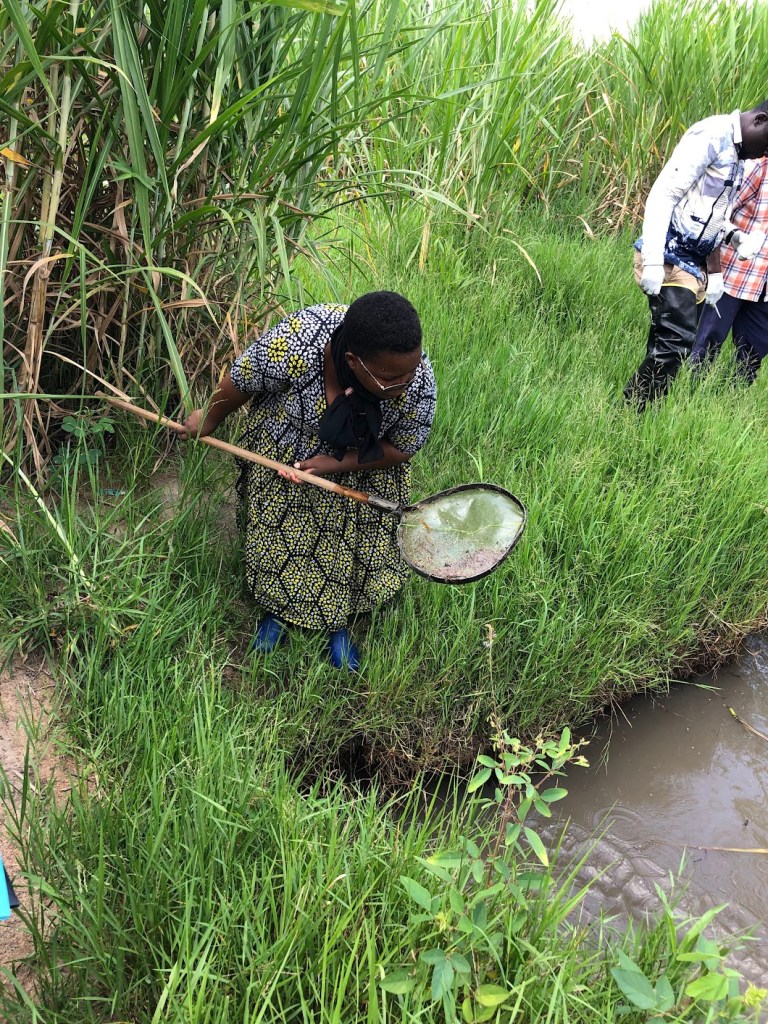
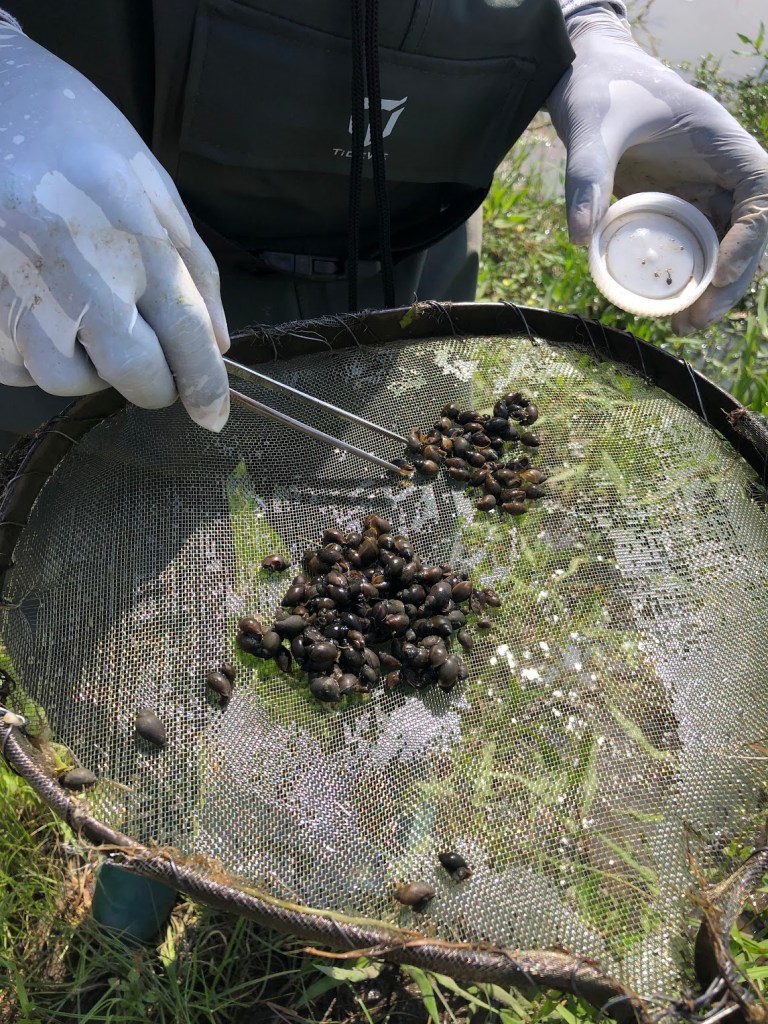
The SNAIL lab conducts research on ecological interactions, disease, and human well-being. We use ecological knowledge to tackle questions of public health importance in human modified landscapes. Ultimately, the goal is to provide insights into intervention methodologies that provide relief to biological and human communities. Below are the main research avenues of the SNAIL lab.
Transmission risk of snail-borne diseases across seasonal agricultural landscapes
Snail-borne diseases, such as schistosomiasis, can be debilitating to humans, livestock and wildlife. However, the risk of contracting these diseases is highly variable across space and time, in part due to their complex life cycles involving many host species. We primarily study how snail-parasite dynamics vary across space and time in rural agricultural ecosystems in Tanzania. These snails have an astounding ability for resilience (prolonged inactivity through dormancy) through harsh dry seasons, which ultimately could benefit the transmission of parasites. The question is can we compromise this seasonal resilience to mitigate diseases? The ultimate goal is to provide affected communities with insights into disease control methods that do not comprise other socioeconomic needs. We use a combination of field surveys, laboratory experiments, statistical modeling, and social science methods to tackle these questions.
The SNAIL lab is has also started a project on the seasonality of snail-borne disease in agricultural landscapes in the Netherlands. Over 50% of land in the Netherlands is agricultural, resulting in both the extensive use of nitrogen and its deposition into the environment. Host-parasite dynamics can be shifted if increased nitrogen deposition impacts on the population, phenology, and/or physiology of either player of this biotic interaction. For example, a number of dutch snail species can be infected by a globally important parasitic worm called Fasciola hepatica, that also infect sheep and cows (and humans, in a worst-case scenario).
Interactions of mercury pollution and snail-borne disease in small-scale gold mining landscapes
Infectious diseases and heavy metal pollution often co-occur, contributing to significant global public health burden. Yet we lack an understanding of the interactions between these two stressors. On the one hand, environmental pollutants are known to promote disease if contamination disrupts the physiological functioning of hosts, such as immune systems, increasing the likelihood and severity of infections. This could be exacerbated by environmental changes creating more vector habitats. Alternatively, heavy metal pollution may also impact the fitness of parasites and reduce their transmission in hosts. The complexity of this interaction is particularly apparent for multi-host parasitic systems with several points of contact through their transmission cycle.
Community science to sure up the sustainability of public health interventions
Equity and justice are at the center of how the SNAIL lab does science. We consider the implications of each of our projects to humans locally and globally, as well as our role as scientists in developing and utilizing knowledge. The ultimate goal of all projects is to provide insights towards sustainable mitigation of public and environmental health issues. Thus, we recognize that our science will always rely on local community knowledge to be effective and sustainable.
Please be in touch if you are interested in working together: n.c.starkloff@uva.nl
Good research relies on strong collaborations.

Publications on snail-borne diseases and public health
NEW PUBLICATION: Mahalila, M.P., Angelo, T., Kinung’hi, S., Civitello, D.J. Starkloff, N.C. (2025). A case of schistosomiasis and healthcare seeking in Mwanza, Tanzania. Trends in Parasitology.
Angelo, T., Starkloff, N.C., Charles, J., Mahalila, M.P., Civitello D.J. & Kinung’hi, S. (2025). Mapping of snail intermediate host habitats reveals variability in schistosome and non-schistosome trematode transmission in an endemic setting. Current Research in Parasitology & Vector-Borne Diseases, 8:100299
Mahalila, M.P., Kinung’hi, S., Civitello, D.J. Starkloff, N.C. (2025). Uncovering Resilience: Dry Season Snail Survival in Tanzania With Implications for a Neglected Tropical Disease. The Bulletin of the Ecological Society of America, e70002.
Starkloff, N.C., Mahalila, M.P., Kinung’hi, S. & Civitello D.J. (2024). Resting in plain sight: Dormancy ecology of the intermediate snail host of Schistosoma Haematobium. Ecology, e4472.
Starkloff, N.C., Angelo, T., Charles, J., Mahalila, M.P., Kinung’hi, S. & Civitello D.J. (2024). Spatiotemporal variability in transmission risk of human schistosomes and other animal trematodes in an East African seasonally desiccating landscape. Proceedings of the Royal Society B, 291: 20231766.
Angelo, T., Starkloff, N.C., Charles, J., Mahalila, M.P., Civitello D.J. & Kinung’hi, S. (2023). Mapping of snail intermediate host habitat reveals variability in human schistosome and cattle trematode parasite transmission in an endemic setting. bioRxiv, 2023.06.04.543635.
Starkloff, N. C. & Civitello, D. J. (2022). Cascading impacts of host seasonal adaptation on parasitism. Trends in Parasitology, 38(11), 942-949.
Starkloff, N. C., Hartman, R. B. & Civitello D. J. (2022). Snail juvenile growth rate as a measure of the transmission potential of parasitizing schistosomes. Experimental Parasitology, 242, 108378.
Civitello, D. J., Angelo, T., Nguyen, K. H., Hartman, R. B., Starkloff, N. C., Mahalila, M. P., … & Rohr, J. R. (2022). Transmission potential of human schistosomes can be driven by resource competition among snail intermediate hosts. Proceedings of the National Academy of Sciences, 119(6). (Winner of ESA George Mercer Award 2023 for Outstanding Ecology Paper)
Swart, E. M., Starkloff, N. C., Ypenburg, S., Ellers, J., van Straalen, N. M., & Koene, J. M. (2020). The effect of mating on female reproduction across hermaphroditic freshwater snails. Invertebrate Biology, 139(1), e12275.
Previous work
My PhD work was in ornithology and avian malaria disease ecology. Here is a sampling of publications. Please check out my Google Scholar page for more work.

1. Starkloff, N.C. & Galen, S. (2023). Coinfection rates of avian blood parasites increase with latitude in parapatric host species. Parasitology, 1-8. (Joint winner of Parasitology Journal’s Early Career Research Award 2024)
2. Pulgarín-R, P. C., Gómez, C., Bayly, N. J., Bensch, S., FitzGerald, A. M., Starkloff, N., … & Skeen, H. (2019). Migratory birds as vehicles for parasite dispersal? Infection by avian haemosporidians over the year and throughout the range of a long-distance migrant. Journal of Biogeography, 46(1), 83-96.
Photo credit to Bill Hubick
 the SNAIL lab